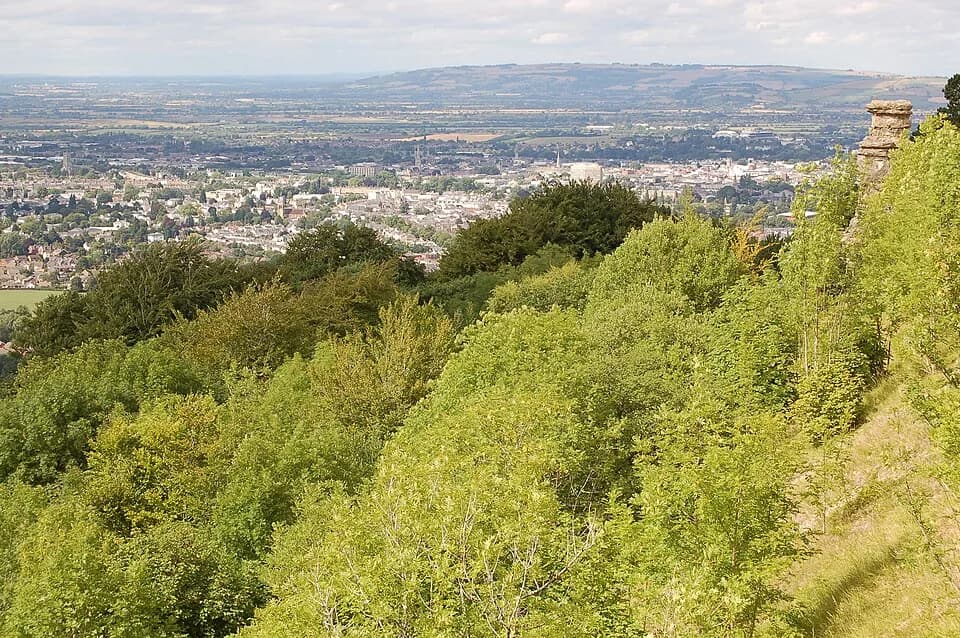
Leckhampton Hill and Charlton Kings Common form a broad stretch of Cotswold escarpment south of Cheltenham - Jurassic limestone grassland, beech and scrub, and the exposed faces of former quarries that supplied stone for much of Georgian Cheltenham. The hill is a Site of Special Scientific Interest for both biology and geology, and in 2026 Cheltenham Escarpment was declared one of the King's Series of National Nature Reserves. On clear days the scarp edge looks out over the town, the Severn Vale, and distant Welsh hills.
Iron Age earthworks, limekiln remains, and old tramway routes still show through the turf. The Devil's Chimney - a slender limestone pillar left standing in the quarry workings - is the best-known landmark on the western edge. Wildflowers and butterflies, including the scarce Duke of Burgundy, favour the unimproved calcareous grassland in summer.
The Cotswold Way crosses the hill on Stages 6 and 7, arriving from Dowdeswell via Seven Springs and Charlton Kings Common, then continuing toward Crickley Hill and Birdlip. Access on foot is free. Parking is available at Daisybank Road (off Leckhampton Road) and near the top on Hartley Lane. Paths can be steep, exposed, and muddy after rain. Practical notes are on the Cheltenham Borough Council Leckhampton Hill page and a stile-free circuit is described by the Cotswolds National Landscape.