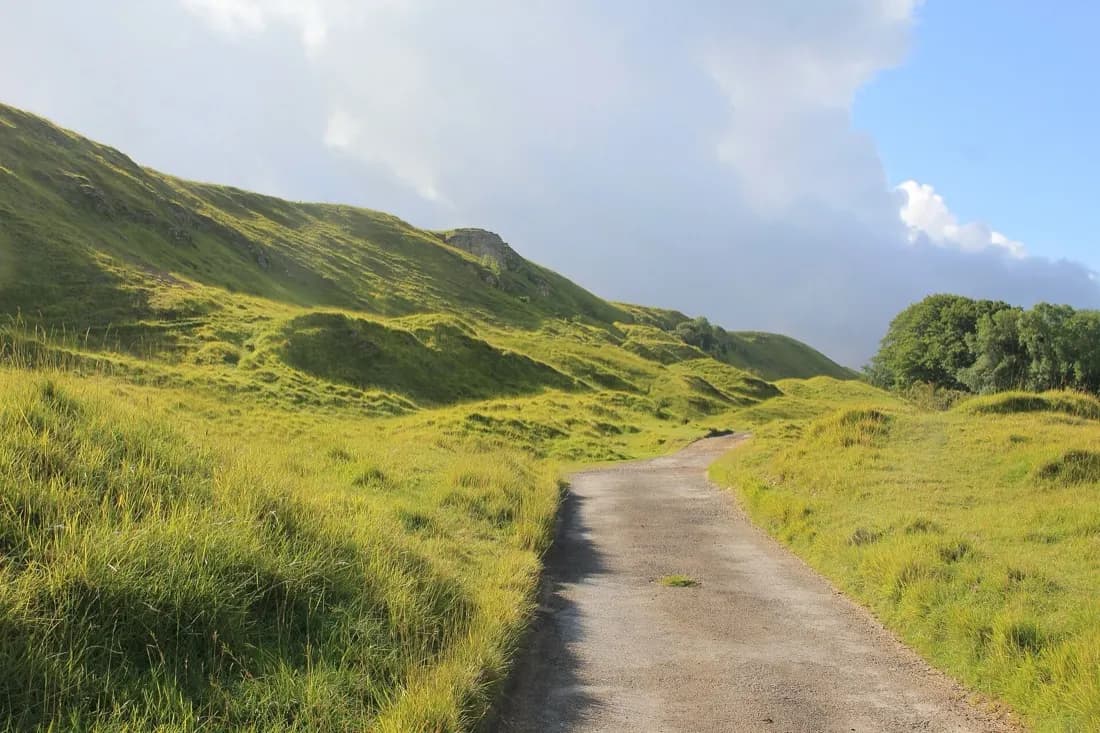
Cleeve Hill crowns the Cotswold escarpment north-east of Cheltenham: at 330 metres (1,083 feet) it is the highest point of both the Cotswolds and the Cotswold Way. The summit is not a sharp peak but Cleeve Common - more than 400 hectares of open limestone grassland, the largest common in the Cotswolds National Landscape. From the western edge, clear days open across Cheltenham and the Severn Vale toward the Malvern Hills, the Forest of Dean, and, in exceptional visibility, the Black Mountains of Wales.
The common is a Site of Special Scientific Interest for its geology, wildflowers, and butterflies, and it holds scheduled archaeological remains as well as the familiar hummocky ground of old limestone workings. Cleeve Common Trust looks after the land. Access on foot is free under open-access rules; keep dogs under close control, especially near livestock and in the nesting season, and stick to established paths so the grassland is not worn bare.
The Cotswold Way crosses the common on Stages 4 and 5 - arriving from Winchcombe via Belas Knap, then continuing south toward Dowdeswell and Cheltenham. The stretch is exposed: wind and sudden weather changes are normal, and there is little tree cover. A lonely beech near the high ground is often called the highest tree in the Cotswolds and makes a natural pause. Practical notes, parking, and the visitor code are on the Cleeve Common Trust website.
On Winchcombe to Cleeve Hill and Cleeve Hill to Dowdeswell.
Stay in Cleeve Hill.
On the path in the 4-day itinerary; on the path in the 7-day itinerary; an afternoon visit in the 10-day itinerary; an afternoon visit in the 15-day itinerary.